
Initiation vs. Counter-Initiation: Coherence or Dissolution
Why initiation demands reason, individuality, and architectural thinking — and why the counterfeits offer only fragmentation and escape.

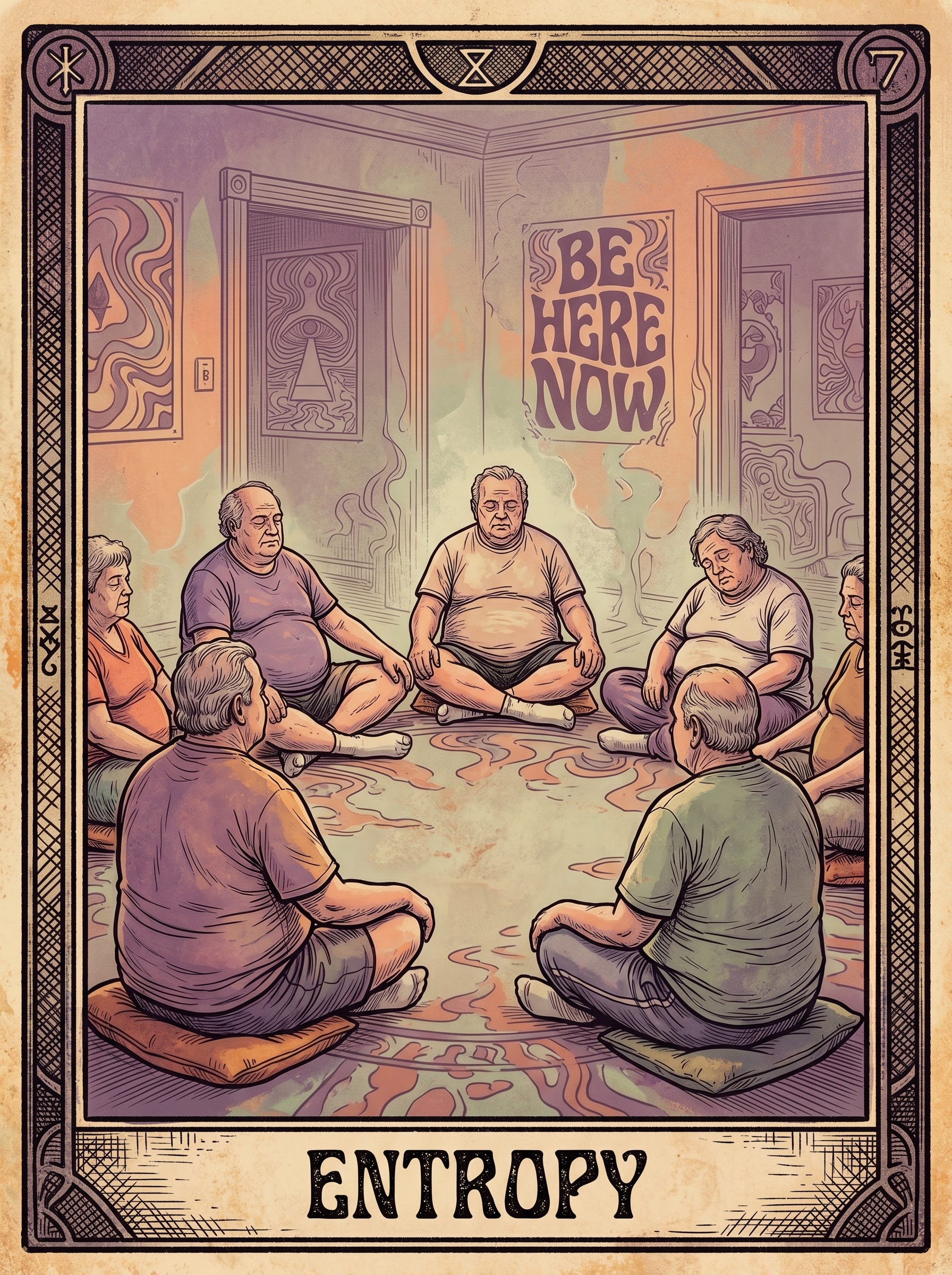
The foundational error of contemporary spirituality is the belief that dissolution equals development. This error is not innocent. It has a structural function within the spiritual marketplace, and understanding that function is the first act of genuine resistance.
You are told to let go. To surrender. To dissolve the ego. To merge with the great ocean of being. Beneath the soothing language lies a consistent mechanical message: become less. Become formless. Become a nullity. And then, having become nothing, you will finally be something.
This inversion is worth examining carefully because it reverses the actual mechanism of transformation. A node, in Gurdjieff’s terms, is a point of crystallization. It receives, holds, transforms, and passes upward. The machine that runs on human attention and consumption cannot use a node. Nodes function independently, which makes them dangerous to any system designed to process raw material rather than cultivate agents. The machine runs on nullities, on the formless and undifferentiated, on people who mistake feeling good for becoming real.
Every silent retreat, every breathwork seminar, every “embodiment workshop” that replaces transformation with experience functions as a factory for nullities. The mechanism requires no one’s conscious belief. Only participation.
The abnormal conditions
Gurdjieff did not believe that the world as it exists provides the right conditions for human development. This is not pessimism. It is a diagnostic observation. You are born into conditions that actively prevent transformation, that keep you asleep, that reward dissolution and punish crystallization.
Consider what you are told from birth. Adjust. Fit in. Be reasonable. Do not make waves. Find a comfortable niche and stay there. This message is encoded in institutions, advertising, parenting advice, and the ambient social cues you breathe like air. The goal is not to become a node. It is to become a well lubricated component in a system that has no interest in your development. A nullity that knows its place. An entity running programmed routines without genuine autonomy.
These are abnormal being conditions, not because they are rare, but because they are actively hostile to human development. A plant needs sunlight, water, and mineral soil. Put it in a closet with artificial light and chemical sludge, and it will survive in some stunted form, but it will never become what it could become. The same applies to human beings in a culture of distraction, consumption, and enforced positivity. They survive as nullities. Soft, adaptable, endlessly entertained, and incapable of transformation.
Most people never know they are in a closet. They assume their stunted condition is normal. Any suggestion that they could become something more feels like an attack. This is not their fault, but it is their responsibility. The first responsibility of anyone who wants the real work is to stop pretending the abnormal is normal. To name the nullity. To see the mechanism for what it is.
Heroism as a technical term
The word “heroic” has been drained of meaning by pop psychology and the spiritual marketplace. In its genuine sense, heroic means the capacity to face something that could break you and not run. To stand in the friction when every instinct tells you to escape. To choose the furnace over the warm bath when everyone around you insists warmth is the point.
The work is heroic because the conditions are abnormal. In a healthy culture, the work would still be difficult but not lonely. You would have support, elders, rituals designed to help you crystallize, and a social order that understood why density matters. You have none of that. You have a culture that mocks transformation, a spiritual marketplace that sells dissolution as liberation, and a social environment that punishes density.
To do the work anyway, knowing this, is heroic. Not because you are special, but because you have looked at the conditions, assessed the cost, and decided that becoming real is worth more than staying comfortable. Gurdjieff did not sugarcoat this. The sleepers and the adjusters do not survive. They merely persist. And persistence is not growth.
The domestication of the path
The heroic path has been domesticated. The sharp edges sanded off. The furnace replaced with a warm room. This transformation is not an accident. It is the work of a generation committed to what Gurdjieff called the “evil god” Self Calming.
The original path demanded leaving comfort, seeking friction, and intentional suffering. Sacrifice of sleep, leisure, identity, and the stories you tell yourself about why you cannot change. The path was not designed to fit into a normal life. It was designed to destroy a normal life, because a normal life in abnormal conditions is not a life at all.
Now look at what passes for the path. A weekend workshop in a hotel conference room. A meditation cushion in a living room that also contains a laptop, a latte, and an NPR tote bag. A method presented in soothing tones that avoids direct challenge, because challenge might hurt feelings and hurt feelings mean bad reviews. The whole apparatus fits seamlessly into the lifestyle of the professional managerial class. It does not disrupt that existence. It enhances it. You get to feel spiritual while continuing exactly as before.
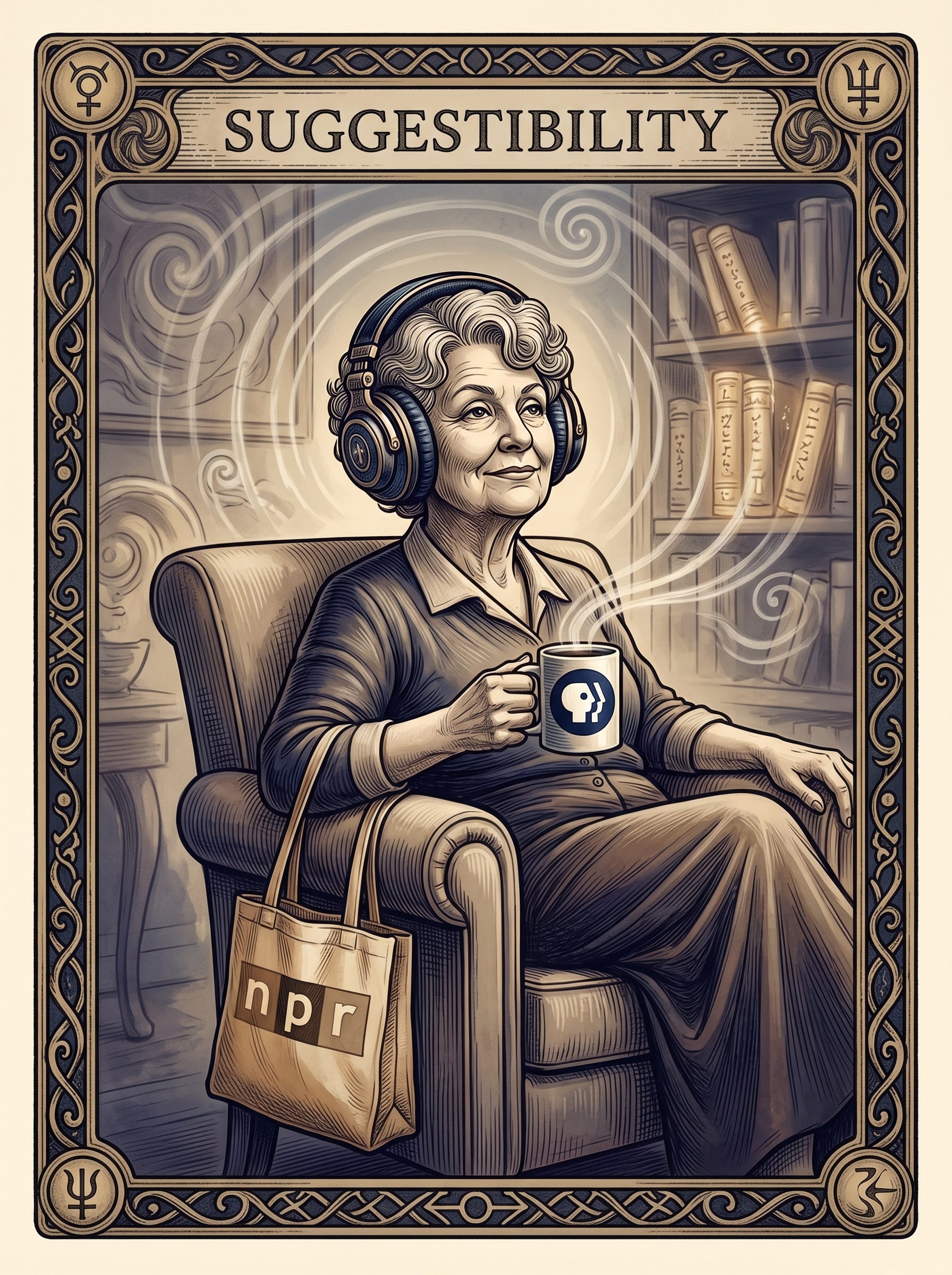
This is the function of Self Calming. The mechanism does not demand explicit sacrifice. It demands that you feel good about not doing the work. That you mistake the absence of discomfort for the presence of development. That you take the heroic path, strip it of everything heroic, and call the remaining husk by the same name.
Self Calming is not a deity in any conventional sense. It is a description of a behavioral loop. Choose the soft path every time the hard path is offered. Attend the sitting instead of standing in the friction. Stay comfortable. In return, you receive permission to feel spiritually advanced while remaining exactly the same.
The hero’s journey, reconsidered
Joseph Campbell’s work on the hero’s journey entered the popular imagination largely through George Lucas, who explicitly used Campbell’s monomyth to structure Star Wars. The shape of the journey is familiar: a call to adventure, a crossing of the threshold, trials and ordeals, a return with the boon. But Campbell was not merely describing a pattern he had observed. He was also, perhaps without fully recognizing it, part of the softening. His framework, for all its erudition, stripped the hero’s journey of its specific cultural and initiatic contexts and made it available for mass consumption. He was one of the instruments of distortion, not an exception to it.
Consider the scene that has become something of a mantra for the culture of letting go. Obi Wan Kenobi, vanishing into the Force, tells Luke: “Let go.” In context, the instruction is precise. Luke must stop trusting his targeting computer, stop relying on his ordinary faculties. Absorbed into the broader therapeutic spiritual vocabulary, “let go” becomes permission to dissolve. To stop trying. To abandon the tension that makes transformation possible.
The popular understanding of the hero’s journey now assumes that the goal is ego death. The hero returns as a selfless vessel, a blob of enlightened formlessness who has transcended the messy business of being a particular someone. This interpretation gets the direction of the transformation precisely, catastrophically wrong.
In the actual heroic sagas, the ones Campbell drew from but ultimately diluted, the hero emerges more, not less. A demigod, not a blob. Heracles does not complete his labors by dissolving into the undifferentiated, becoming one with the Great Nothingness. He becomes Heracles. He crystallizes. He passes through fire, through poison, through the impossible, and on the other side he is not a nullity. He is a god.
Odysseus returns to Ithaca as Odysseus, sharper, harder, more himself than when he left. Beowulf returns from Grendel’s mere having proven the self, densified it, become a node that the tribe can gather around. These heroes did not attend weekend workshops. They bled. They lost people. They made enemies. They did things that cannot fit into a lifestyle.
The hero’s journey is a journey into crystallization. The hero faces fire and does not melt. Faces the abyss and does not dissolve. Faces the monster and becomes something solid enough to strike back. Not the abandonment of self, but the forging of a self worth having. Not the death of the ego, but the death of the false, fragmentary, reactive ego and the birth of a real “I” that can stand in the friction without shattering.
Here is the relevant question, the one the spiritual marketplace will never ask you: If you have no I, what will you sacrifice? What will you transform? The answer is nothing. You become a nullity. A character in someone else’s story, programmed to feel spiritual while remaining unchanged. That is the journey of the consumer. It ends not in apotheosis but in absorption.
The mechanism of the marketplace
You will not get the work in your work weekends or your silent sittings. The people running those events may be sincere, in the sense that the term is commonly used. But sincerity is not a guarantee of accuracy. In fact, the mechanism of Self Calming operates most effectively through sincere people who genuinely believe they are helping while they replace work with experience.
Consider the structure of a typical “transformation” weekend. You sit in a comfortable room. You listen to a soothing voice. You have experiences curated to be challenging enough to feel meaningful but not so challenging that they threaten your existing structure. You feel expanded. You might cry, the kind of crying that feels like release. Then you go home and nothing has changed. You are still a nullity, but now with a memory of feeling like something more. That memory becomes a substitute for the work itself.
This is the structural genius of the spiritual marketplace. It does not need to convince you to stop seeking. It needs to convince you that seeking is the same as finding, attending the same as transforming, paying for pleasant feelings the same as sacrificing your comfort. You leave feeling virtuous. You post about it. You tell your friends you are doing the work. And you are doing nothing. Running away from the struggle, the friction, the only thing that could make you real.
Gurdjieff watched this happen with the Theosophists, the neo Hindus, and the occult revivalists of his time. Mountains of papers. Endless lectures. Beautiful ceremonies. No transformation. Because transformation requires struggle, and struggle is exactly what those movements helped people avoid. They sold the feeling of work without the work itself. The identity of a seeker without the reality of seeking. Permission to abandon duty while feeling spiritually advanced.
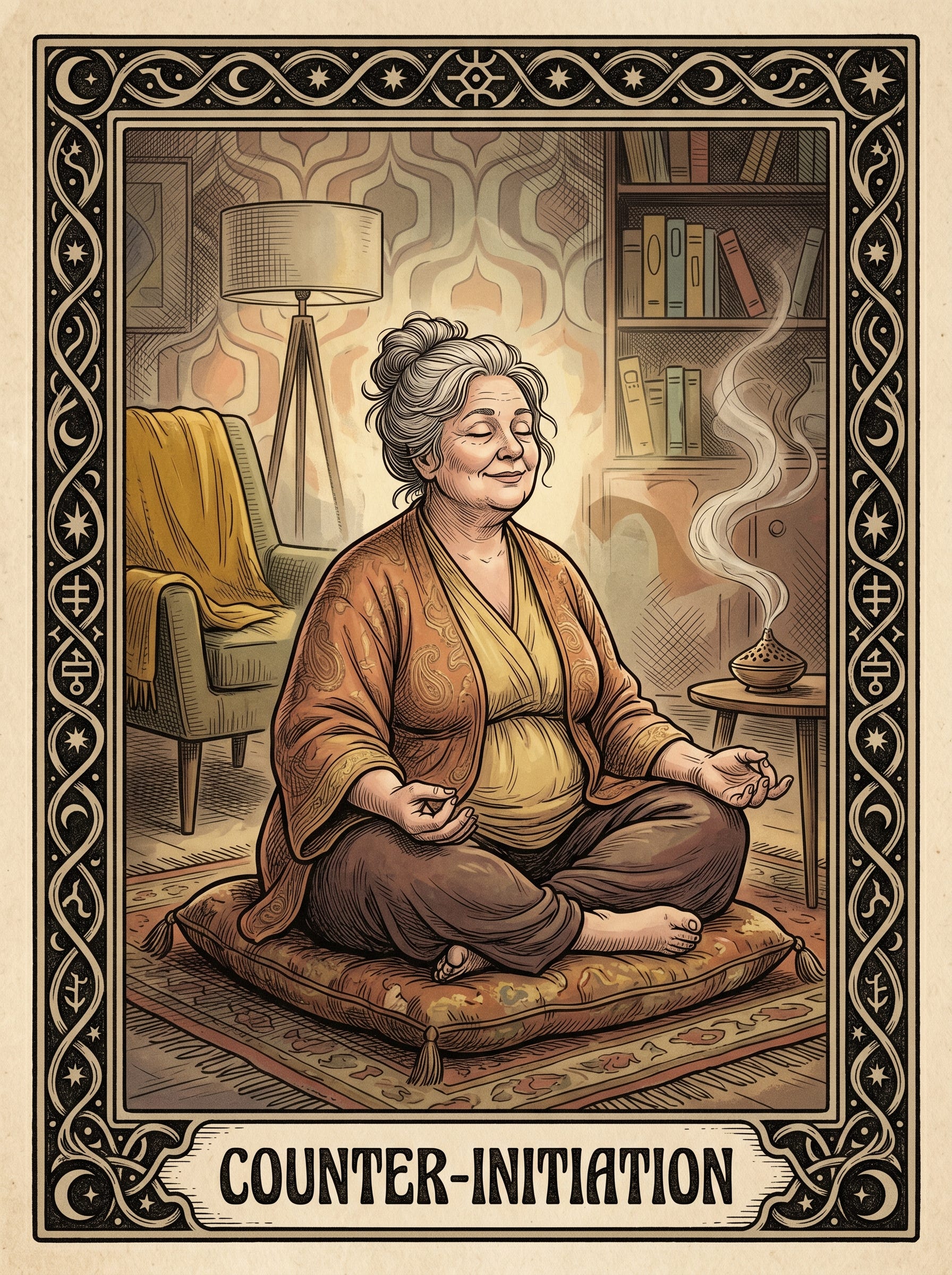
The difference between real work and the spiritual marketplace is not subtle. Real work feels like dying. Not once. Every day. It asks you to give up the identities you have built, the comforts you have accumulated, the stories you have told yourself about why you cannot change. It demands you stand in the friction when everything in you wants to run. Real work does not fit into a lifestyle. It destroys lifestyles. It is incompatible with the laptop and latte existence, not because those things are evil, but because they are designed to keep you comfortable, and the work requires discomfort.
The spiritual marketplace offers relief from the very friction that could save you. A soft path to nowhere. Abandonment of duty wrapped in the language of growth. All of it for a fee, because the machine that runs on human nullity is happy to take your money.
The inheritance
Some of you were given something at birth. Not a finished product but a potential. The potential to become a real “I.” A node. A transformer. A point in the cosmos where substances could rise rather than circulate. That inheritance is the only thing you truly own.
You are trading it for feels. Temporary, pleasant, self validating sensations that leave you exactly where you were except slightly more addicted to the next hit. Self Calming is the name for this exchange mechanism. It does not ask you to give up your inheritance. It asks you to trade it for something that feels like more but is actually less.
Your chance to become a demigod, or at least a functioning human, rather than an NPC, traded for a weekend of feeling good about yourself. Consider the economics of that exchange. Millions make it every day because the feels are immediately available and the work is hard and slow and offers no guarantees. Self Calming has made the bad trade feel like the smart trade.
Gurdjieff saw people with genuine potential throw it away for cheap satisfactions. They wanted to feel enlightened without being enlightened. The admiration of peers without the solitude of real work. The identity without the sacrifice. They got exactly what they wanted. They got the feels. And they lost everything else.
Every time you choose a work weekend over actual work, a sitting over standing in the friction, the soft path over the hard path, you are burning your inheritance. Taking the raw material of what you could become and throwing it into a fire that produces nothing but warmth.
The mechanics of friction
The culture of passive acceptance and the work weekend economy share a common function. They hide the role of friction. Friction is not your enemy. Friction is the only thing that can produce transformation.
The abnormal conditions of modern life produce enormous friction. The noise, the distraction, the false emergencies, the social pressure to conform, the loneliness, the sense that something is deeply wrong. Most people try to reduce this friction. They numb it, medicate it, scroll past it. They treat friction as a design flaw to be eliminated.
This is backwards. Friction produces being. Two things rub together. The rubbing produces heat. The heat produces change. Without friction, no heat. Without heat, substances never transmute. They lie inert, unchanged, waiting for a friction that never comes. The abnormal conditions are terrible for living but excellent for friction. They provide endless opportunities to choose crystallization over dissolution.
The task is not to adjust to the world of nullities. Adjustment is surrender. The task is to use the friction of life to become solid. To take every irritation, disappointment, and moment of cognitive dissonance, and turn it into material for the work. To let the friction burn away what is false until only what is real remains. Years of conscious suffering. Intentional friction. Refusing the escape hatch even when it is right there in front of you.
Gurdjieff called this intentional suffering. Not the suffering that happens to you. That is just pain. Intentional suffering is suffering you choose, suffering you use, suffering that serves a purpose. You stand in the friction instead of running. Hold the tension instead of dissolving it. Let the heat do its work even when you would rather be anywhere else. That is how you become solid. A node.
The binary
A node is a point of transformation. It receives something, works on it internally, and produces something else. Structure, boundaries, density. Functional within the trogoautoegocratic process. What you become when you refuse to be a nullity.
A nullity is the opposite. No structure, no boundaries, no density. Receives and releases without transformation. A hole. Energy pours in and vanishes, unused, unavailable to anything higher. The end of the line. The ideal product of Self Calming.
You cannot become a node if you accept everything. If you have no standards, no boundaries, no capacity for rejection. The node says no to what degrades, yes only to what elevates. It discriminates constantly, not out of judgment, but out of mechanical necessity. You cannot transform what you cannot distinguish.
The arithmetic of the work
This is where the modern liberal mindset hits a wall it cannot climb. The work is not for everyone. It was never for everyone. In the best of times, across the healthiest cultures, the proportion of human beings with the potential for genuine transformation was a small fraction. Most people do not have the raw material. Most people cannot become nodes. They are not built for it, and no amount of encouragement or workshop attendance will change that.
Under the abnormal conditions of modernity, that fraction shrinks further. Almost no one has the potential. The machine sees to that. It selects for nullities and produces them efficiently. Modernity can practically be defined as an arrangement of conditions designed to remove the necessary factors for the development of candidates for initiation. Comfort replaces friction. Distraction replaces attention. Consumption replaces being. The result is not a population of potential heroes. It is a population of potential customers.
So let me be precise about this. There are candidates for transformation. There always have been. They are the ones who, when faced with the friction, do not run. They are the ones who feel the abnormality of their conditions and refuse to adjust. But I am not recruiting for an organization. I have no group to offer you, no membership tier, no newsletter call to action. The work has no waiting list because the work has no door policy. The door is made of your own desperation. Either you go through it alone or you do not go through it at all.
The New Testament says it plainly. “Enter through the narrow gate. For wide is the gate and broad is the road that leads to destruction, and many enter through it. But small is the gate and narrow the road that leads to life, and only a few find it.” An esoteric effort that is not turning away eighty or ninety percent of applicants is not even in the game. If an open door and a waiting list define your access, you are in a social club with spiritual wallpaper, not a furnace. The door is narrow because the work breaks what cannot bear the stress. That is not cruelty. It is simple physics. You do not put soft metal into a forge meant for steel. It will melt into slag, and you will have wasted the metal and the heat.
And here is the other thing the soft path will never tell you. The promises are not for everyone. They are for those who overcome. The book of Revelation is explicit about this. “To the one who overcomes, I will give the right to eat from the tree of life, which is in the paradise of God.” Again: “To the one who overcomes, I will give some of the hidden manna.” And again: “To the one who overcomes, I will give the right to sit with me on my throne.” Not to those who attend. Not to those who feel. Not to those who dissolve. To those who overcome. Overcoming requires something to overcome. It requires friction. It requires a self solid enough to stand. You cannot overcome if you have already dissolved into nothing.
This is not elitism for its own sake. It is accuracy. And accuracy is the first duty of anyone who claims to be serious about transformation.
The machine runs on nullities. It has no use for nodes. The spiritual marketplace sells the feeling of transformation at a price that guarantees no transformation occurs. Friction is the mechanism of being, not an obstacle to it. Self Calming is the behavioral loop that keeps you comfortable and unchanged. Heracles became a god. You are being asked to become a blob.
The work exists, but it is not for you unless it is for you.
That is the case. No recruitment pitch. No gentle invitation to begin your journey. The only question is whether you have the potential and the desperation to find it anyway. Most do not. The machine will digest them. That is not a tragedy. It is just what the machine does.